Florida F2S Academy: Producers
The Florida F2S Academy provides farmers and producers with the resources you need to unlock a new business opportunity: selling to schools.
Whether you’re exploring Farm to School for the first time or looking to expand, our Florida F2S Academy and dedicated Farm to School team are here to help.
Access Resources Book a One-on-One Explore Events Virtual Producer Trainings
What to Expect from the Academy
Just last year, Florida schools spent over $34 million on local food. Through the Academy, we’ll teach you how to tap into that market with guidance, tools and a team that’s ready to support you, with:
- One-on-one calls with our F2S team. Book time now.
- Virtual Town Halls with guest speakers sharing tips and success stories.
- Virtual Producer Trainings to teach you how to get your food into schools.
- And much more!
Don’t see the resource you’re looking for below? Contact our team.
New to Farm to School? This is a great place to start! Learn how the Florida Farm to School initiative’s three pillars work together to ensure kids, farmers and communities across the state win.
If you are a ending a producer training in your state, you will see that each section in this workbook corresponds with a module from the training. Each section in this workbook covers a different aspect of selling local food products to schools.
This video tutorial will walk you through the steps to create your Florida Farm Connect account and set up your farmer profile. From entering your farm details to highlighting your available commodities, we’ll show you how to make your profile stand out to school buyers across the state.
As a farmer, rancher, fisherman, or other food producer, large or small, this means that there are market opportunities in your own backyard and a chance for your farm’s bounty to nourish children in your community. You can play a role in supplying local products to schools to serve during breakfast, lunch, and snack times, as well as educating students about food and agriculture.
Whether you are producing food or preparing it, keeping food safe is a critical part of healthy eating. Become familiar with best practices for produce safety, including receiving, storing, handling and processing.
This resource supports farmers and producers by providing practical strategies, tools and guidance to connect with schools and understand the process of getting locally grown goods onto school lunch trays.
Using this process map, you can find a way to connect with Florida Farm to School in your community. Each step is a clickable link to assist you on your way to success.
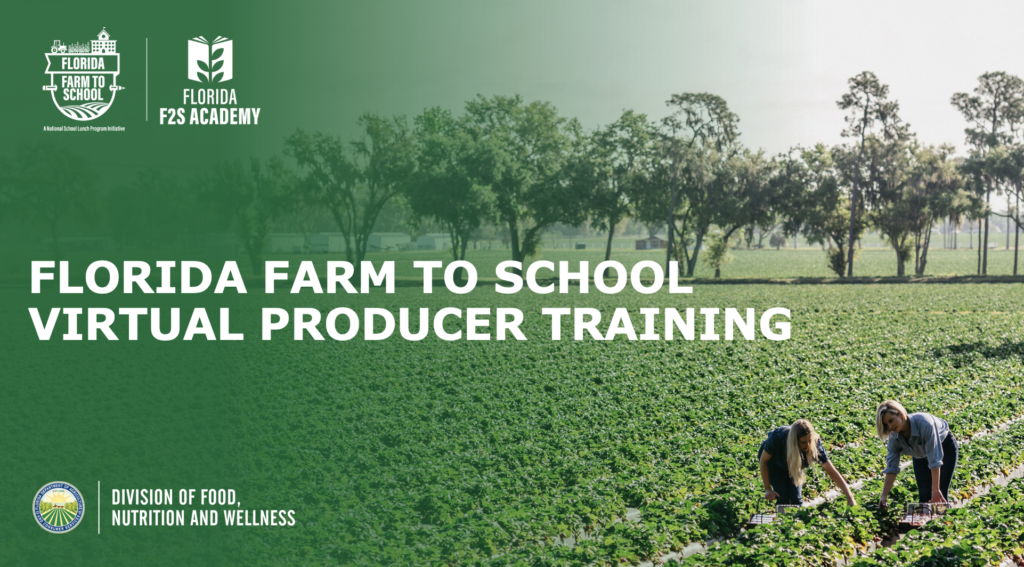
Florida Farm to School Virtual Producer Trainings
Our Virtual Producer Trainings are intended for food producers interested in learning about selling food into local school markets. These self-guided materials will provide insights and actionable next steps to:
- Learn about accessing school markets, the procurement process and growing products for school markets.
- Connect with Florida schools and distributors across the state
- Gain new knowledge and resources for expanding your business to take advantage of school market opportunities.
What are local foods?
Local foods can be from any food group, including meats, eggs, grains, fruits, vegetables or dairy. Each school district sets its own definition for “locally grown or raised.”
This can range from items produced in the school’s county, within a certain mile radius of the school, in Florida or within an hour drive from the school.
The definition can range between products or even change with the season.

Can local meats be served in Child Nutrition Programs?
Yes. Livestock and poultry must be processed under federal inspection.
Can fresh chicken eggs be used in Child Nutrition Programs?
Yes. Eggs must meet requirements set by the Florida Department of Agriculture and Consumer Services.
Can local fruits and vegetables be served in Child Nutrition Programs?
Yes. Local produce can be purchased or donated directly from a farmer, or through a distributor, food hub, farmers’ market, grocer or school garden. Unprocessed fruits and vegetables that retain their inherent character are allowed. Minimal processing, such as freezing or cutting and bagging, is permitted.
Do producers need to be GAP certified to sell local produce to Child Nutrition Programs?
No. GAP (Good Agricultural Practices) certification is voluntary unless an individual school district requires it. Suppliers should follow these food safety practices and provide schools documentation of any farm food safety plans.
What paperwork is necessary to sell to Child Nutrition Program sponsors?
Information about traceability and price, along with food safety assurances and insurance coverage, are necessary when selling to schools.
What are the purchasing processes when selling to schools?
Schools can use three types of processes for purchasing food, depending on the amount they purchase:
- Micro-purchases may be used for purchases under $10,000 ($50,000 in some school districts) without obtaining multiple bids. Schools must distribute micro-purchases evenly amongst qualified vendors.
- Informal process may be used for purchases under $250,000; 3 quotes must be documented and evaluated before selecting the winning quote and making the purchase.
- Formal process is used for purchases over $250,000. Buyers prepare a solicitation, advertise the solicitation, and evaluate and award a contract to the lowest responsible bidder.
See how buyers target local foods using the USDA Decision Tree.
Donations are allowed and may be used for tax purposes. See A Farmer’s Guide to the Enhanced Federal Tax Deduction for Food Donation, available from the National Resource Defense Council.